"What Artemis II Can Teach Us About Mental Health," April 10, 2026

What Artemis II Can Teach Us About Mental Health

On our Wellness Compass podcast this week we talked about how we, as a couple of mental health providers, took away some important lessons from following the outer space journey of Artemis II.

Here, in no particular order, are our takeaways:

There is Power in Expanding Our Perspective. Suppose someone says, "I'm a control freak. I micromanage everything." A helpful reframe you could offer them is: “Sounds like you have high standards and a deep investment in things going well. That care and attention to detail can be a real asset as long as you can find a way to channel it in ways that don't exhaust you or those around you.” The reframe expands the perspective and opens up new ways to see the issue.

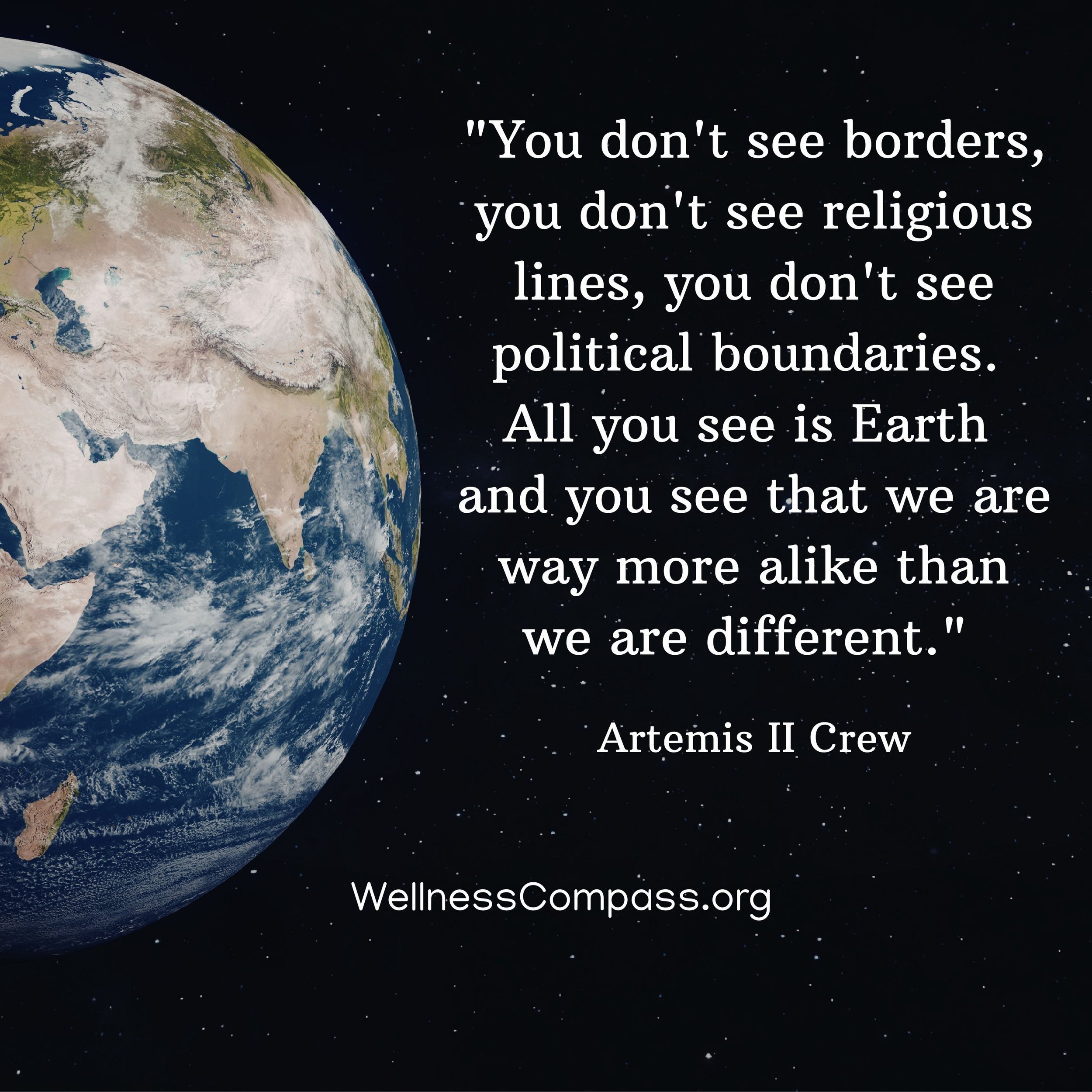
Viewing Earth from space is the ultimate reframe—and (please excuse the pun!) a very high level experience of expanding one’s perspective. The expanded perspective from space removes human-made earthly divisions and helps to remind us that we really are all ultimately one, and in this together.

If You Want to Go Far, Go Together. There is a proverb that says, “If you want to go fast, go alone; if you want to go far, go together.” The four astronauts are a diverse group with unique skill sets. The success of the mission is based on their interconnection and interdependence.  Add to this the much larger team of scientists who built the craft and oversee all the other logistics, and you see that we all definitely do better, and go farther, when we work together, in space and here on Earth.

There is a Time for Autopilot and a Time for Taking the Controls. Many things we do in our day-to-day lives are routines that maybe are not fully on autopilot, but we don’t need to give them a lot of new thought each day. However, there are times, either because of disruption in our lives or because we want to move into a new “orbit,” that we need to turn off the autopilot and truly take control, so that we can fly with greater awareness and intention. This is exactly what the astronauts did on their mission. NASA had each crew member take a turn flying the craft so that they would know what to do in case the autopilot function failed and they needed to take control themselves.

Growth Requires Moving Out of Comfort Zones. Could there be a more powerful example of moving out of one’s comfort zone than choosing to fly to outer space? All change and growth, by definition, requires a decision to move out of our comfort zones. As long as we make this move with awareness, intention, and a supportive team of people around us, we maximize our chances of gaining a whole new perspective in our lives. This can open us to experiences and vistas we never thought possible from within our previous comfort zones.

We applaud the courage and success of the Artemis II voyage and all the people who have made it possible. And as we write this the night before they are due to return to Earth, we thank them for the inspiration and wisdom they have offered us and we wish them a safe and successful landing.

If you want to hear more about our thoughts on this topic, listen to this week’s 10-12 minute episode of the Wellness Compass Podcast, which you can find by clicking on “Podcast” at the top of this page. In this week’s episode you will learn about a unique new way you can interact with the Wellness Compass Podcast that includes recording an audio message that might appear on a future episode.

Speaking of podcasts, Scott has his own podcast, which is just him speaking about a topic that he is passionate about: the integration of spirituality and wellness. The Living Compass Podcast can be found HERE or in your favorite podcast app. There is also a Living Compass app, with guided meditations, courses, and contemplative practices. The app can be found in any mobile phone App Store, and all the content in the app is available from your web browser by clicking HERE.
"Only Love Can Do That," March 27, 2026

Only Love Can Do That

Theo of Golden by Allan Levi is the book I (Holly) am currently reading and loving. Only three quarters of the way through it, the main character Theo and his story has really captivated me as he is everything I’d like to be: curious about others, a good listener to everyone, generous, and non-judgmental.

I’ve been telling Scott about it all week, sharing many of the stories about Theo’s loving kindness and how I find it to be an antidote for much of the suffering that is happening in the world.

Like Theo, we believe that love, kindness, and compassion are the most powerful and most essential forces in the world. We find it important to state this, especially at a time when fear and violence are a constant presence.

We talk in our Wellness Compass resources about how there are many compasses that compete to guide our lives. The compasses of the dominant culture are strong, as are the compasses of our upbringings. Choosing spiritual values, as Theo does—like love, kindness, and compassion—to be what guides us toward True North is an intentional choice any of us can make, no matter what other forces may tempt us to follow them instead.

As psychotherapists, we know firsthand the destruction that violence and hatred cause. Having worked with countless clients who have experienced the mind- and soul-crushing effects of violence and hatred, our hearts have been broken more times than we can count. At the same time, being witnesses to the healing power of love and compassion in the lives of people who have suffered has time and time again reminded us that love and compassion are indeed stronger than violence and hatred.

Hatred and violence are ever present in our world, there is no doubt. As Martin Luther King Jr. said, “Hate cannot drive out hate; only love can do that.” That’s why we need to continuously choose love, kindness, and compassion as our enduring values both for our own well-being and the well-being of our world.

If you want to hear more about our thoughts on this topic, listen to this week’s 10-12 minute episode of the Wellness Compass Podcast, which you can find by clicking on “Podcast” at the top of this page. In this week’s episode you will learn about a unique new way you can interact with the Wellness Compass Podcast that includes recording an audio message that might appear on a future episode.

Speaking of podcasts, Scott has his own podcast, which is just him speaking about a topic that he is passionate about: the integration of spirituality and wellness. The Living Compass Podcast can be found HERE or in your favorite podcast app. There is also a Living Compass app, with guided meditations, courses, and contemplative practices. The app can be found in any mobile phone App Store, and all the content in the app is available from your web browser by clicking HERE.
"The Gift We So Often Forget to Give Ourselves," March 13, 2026

The Gift We So Often Forget to Give Ourselves

Two of the most important gifts we can offer ourselves—and ones that are often overlooked—are the practices of self-compassion and self-care. Kristin Neff, one of the leading experts in the self-compassion movement, offers a beautifully simple starting point: "Treat yourself as you would a good friend."

It sounds straightforward, yet for many of us it is surprisingly difficult. Those who are quite compassionate and caring with others can, perhaps surprisingly, be unduly hard on themselves, and tend to care for themselves last. Learning more about self-compassion has helped both of us enormously—and the research confirms we are not alone. Who doesn't have an inner critic?

The need for self-compassion and care is real for people of all ages. I, Holly, was recently at a mental health fair for teens, talking with them about Wellness Compass and mental health. Many shared how down on themselves they get when they don't perform well in school, sports, or other activities. Thoughts such as "I get really mad at myself when I don't do well" were common among them.

For young people especially, social media can significantly magnify feelings of self-criticism for an already vulnerable teen. Teaching young people mindful self-compassion and intentional self-care helps them quiet their inner critics and practice loving, accepting, and appreciating themselves for who they are. It also helps them normalize the natural ups and downs that people of all ages experience throughout life—and recognize that self-care isn't selfish.

We adults can benefit just as deeply from the practices of self-compassion and self-care. It’s so easy for to become so focused on caring for others that we neglect to turn that same care inward. And lest you think these practices are self-indulgent, they are not. They are, in fact, what makes sustained compassion for others possible.

If you would like to explore self-compassion further, we highly recommend watching this short video from self-compassion author, teacher, and researcher Kristin Neff. You can watch the video HERE.

Life is hard and uncertain for many right now, making this a good time to consider giving ourselves the gifts of both self-compassion and self-care.

If you want to hear more about our thoughts on this topic, listen to this week’s 10-12 minute episode of the Wellness Compass Podcast, which you can find by clicking on “Podcast” at the top of this page. In this week’s episode you will learn about a unique new way you can interact with the Wellness Compass Podcast that includes recording an audio message that might appear on a future episode.

Speaking of podcasts, Scott has his own podcast, which is just him speaking about a topic that he is passionate about: the integration of spirituality and wellness. The Living Compass Podcast can be found HERE or in your favorite podcast app.

"The Courage to Reset: Lessons from an Olympic Champion," February 27, 2026

The Courage to Reset: Lessons from an Olympic Champion

Alysa Liu won two Olympic gold medals in figure skating this month at the age of 20. We were both mesmerized by her. Yes, her skating was delightful and amazing to behold, but what left us mesmerized was her spirit—her joy, her presence, and her story.

To start this new year we have been writing a series of articles about change, as many people hope to change something in their life at the beginning of the new year. Alysa Liu embodies one of the most important aspects of change: knowing when it is time to choose to reset.

Any of us can find ourselves on a path that is leading us to a place that doesn't feel good, maybe even to exhaustion and burnout. Perhaps, like Alysa, we are living from the "outside, in," going through the motions—working hard or pursuing a goal at any cost, afraid of what others might think if we don't keep on keeping on. At times like that it can seem easier to just keep doing more of the same. We might even feel too tired to consider a reset.

Knowing when to prioritize one's mental health and having the courage to choose a reset is exactly what moved us about Alysa Liu's story. She became the youngest ever U.S. national champion at age 13 in 2019. She competed in the 2022 Beijing Olympics at age 16, finishing sixth.

Shortly after Beijing she announced her decision to step away and retire at age 16—a decision that seemed sure to end any hopes of future success. She chose to prioritize mental health, joy, and overall wellbeing. She took two years off to care for her mental health and to learn what it felt like to be a “normal teenager.” She only came back when she eventually reconnected with her joy for sharing her art with others. In fact, that is how she described her approach to the Milan Olympics. In her own words: "This time just feels so completely different. I know who I am as a person now. And I love my training. It's even really fun, and I am more present for sure, more happy and fun."

Like gold medalist Simone Biles, Alysa has been open about her mental health challenges. Again, in Alysa's own words: "I hope that with all this attention, I can at least raise awareness about mental health and sports, and mental health in general."

For us, we take away several key lessons from Alysa and Simone.

Resting or resetting is not quitting.

Detaching our wellbeing from achievement or our role is essential.

And listening to the whispers and warning signs that a reset is needed—and then having the courage to act on them—is crucial.

Here's one final quote from her: "I think my story is pretty cool, so I hope that it inspires some people as well."

We think her story is indeed pretty cool, and it serves as a reminder for all of us to wonder if there is something we are doing right now that might benefit from stepping back or some kind of reset—not as defeat, but as an act of wisdom and self-care.

*Photo of Alysa Liu Credit: By YantsImages - Own work, CC BY-SA 4.0, https://commons.wikimedia.org/w/index.php?curid=184533407

If you want to hear more about our thoughts on this topic, listen to this week’s 10-12 minute episode of the Wellness Compass Podcast, which you can find by clicking on “Podcast” at the top of this page. In this week’s episode you will learn about a unique new way you can interact with the Wellness Compass Podcast that includes recording an audio message that might appear on a future episode.

Speaking of podcasts, Scott has his own podcast, which is just him speaking about a topic that he is passionate about: the integration of spirituality and wellness. The Living Compass Podcast can be found HERE or in your favorite podcast app.

"Love as Practice: Beyond the Feelings of Valentine's Day," February 13, 2026

Love as Practice: Beyond the \Feelings of Valentine's Day

Valentine's Day invites us to celebrate love with cards, flowers, and chocolates—gestures that honor the warm feelings we have for the people we care about. Feelings are an important aspect of love, but love is so much more than that. What sustains love through ordinary days, difficult seasons, and genuine hardship?

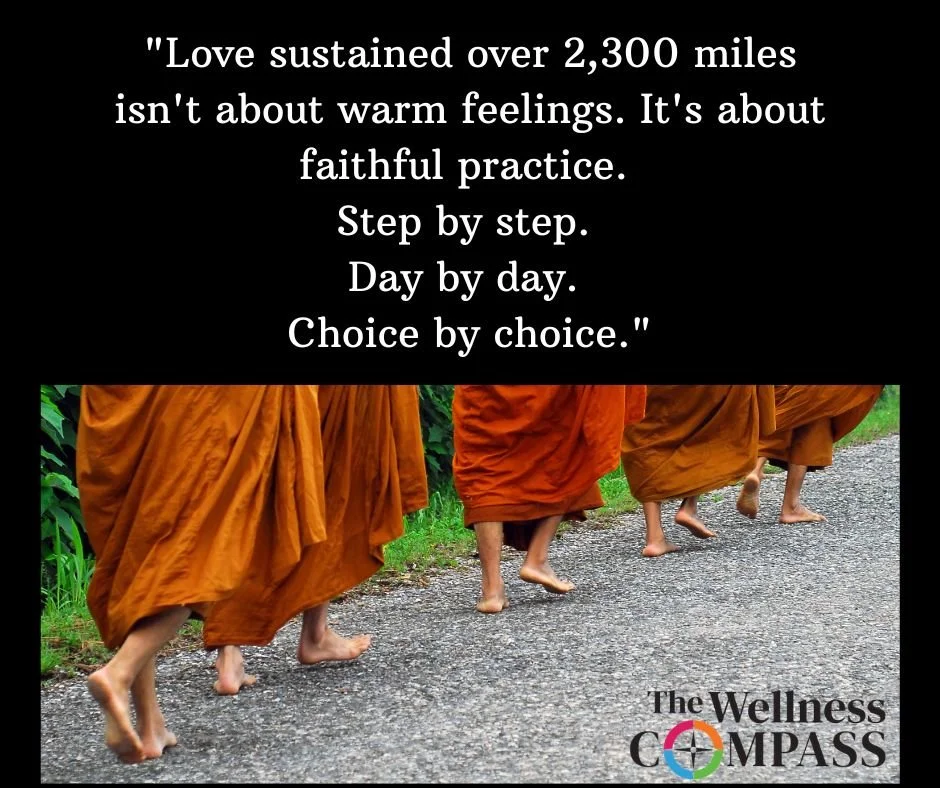
This week, nineteen Buddhist monks completed a 2,300-mile walk from Texas to Washington, D.C., covering over twenty miles each day for 108 days. Some walked barefoot. Some nights they slept in tents in the midst of freezing weather. Early in their journey, their escort vehicle was struck by a distracted driver, and one monk lost his leg. Rather than responding with anger or litigation, the monks offered compassion and continued their pilgrimage.

Their journey teaches us something essential: love is not primarily a feeling. Love is an embodied practice—a decision we make again and again through our actions.

American scholar and author bell hooks wrote that, "Love is an act of will—namely, both an intention and an action." She insisted that love requires care, commitment, knowledge, responsibility, respect, and trust. These aren't emotions that wash over us. They're disciplines we can choose to cultivate, day after difficult day.

This understanding has for centuries appeared across wisdom traditions as well. In the Bible, for example, in 1 Corinthians 13, love is described not as a feeling but as a series of actions: love is patient, love is kind, love does not keep a record of wrongs. These are choices, not sentiments. They require intention and practice.

The monks' walk demonstrates this truth beautifully. When faced with injury and loss, they couldn’t rely solely on positive feelings to carry them forward. They instead relied on their commitment to peace—a commitment expressed through every mindful step, every tent pitched in the cold, every encounter with strangers along the highway.

Their example has profound implications for our relationships. When we understand love as practice rather than feeling, we stop waiting for the emotion to show up before we act lovingly. We show up for our partner even when we're frustrated. We offer kindness to our children even when we're exhausted. We extend compassion to ourselves even when we feel unworthy of it.

Love as practice means recognizing that the small, unglamorous choices matter most: listening when we'd rather talk, pausing before reacting, choosing forgiveness over resentment, showing up consistently rather than dramatically. These daily disciplines build the foundation that feelings alone cannot sustain.

So this Valentine's Day, by all means celebrate with flowers and chocolates. But also ask yourself: What loving actions will I practice even when the warm, affectionate feelings aren't always there? How will I embody love even when it costs me something? What am I willing to walk twenty miles a day for?

The monks teach us that love sustained over 2,300 miles isn't about warm feelings. It's about faithful practice. Step by step. Day by day. Choice by choice.

That's the love that endures.

If you want to hear more about our thoughts on this topic, listen to this week’s 10-12 minute episode of the Wellness Compass Podcast, which you can find by clicking on “Podcast” at the top of this page. In this week’s episode you will learn about a unique new way you can interact with the Wellness Compass Podcast that includes recording an audio message that might appear on a future episode.

Speaking of podcasts, Scott has his own podcast, which is just him speaking about a topic that he is passionate about: the integration of spirituality and wellness. The Living Compass Podcast can be found HERE or in your favorite podcast app.

"Start With Why," January 30, 2026

Start with Why

(Part 2 of an Updated 6-Part Series on

Understanding Growth & Change)

Most attempts to make a change will fail if they are not connected to a clear "why"—a clear reason for making the change. The "why" is the root system that grounds and nurtures change. Without a strong root system, most attempts at change will wither or die out altogether. For example, if a person makes a New Year’s resolution simply because it’s the popular thing to do, there is a good chance that resolution won’t stick. If, however, a resolution is grounded in a compelling why, it has a much greater chance of lasting.

Author Simon Sinek writes extensively about change. He says most people focus only on the "what" and "how" of a change they want to make, and forget the most essential part—connecting with their "why." For example, a person might decide they want to spend less time on their screens. That's their "what." They may even have a "how"—a plan for doing this. But unless they articulate the deeper "why," their attempt to limit screen time will likely be short-lived. If, however, they can identify why they want to spend less time on screens—to connect more meaningfully with others, pursue other activities, or get more sleep—then there's a greater chance they'll make a lasting change.

All great leaders inspire and facilitate change with a clear "why." Archbishop Desmond Tutu, who passed away in 2021, received the Nobel Peace Prize for his tireless work to end apartheid in South Africa. The “why” that kept him going, even when facing seemingly insurmountable barriers, was his belief that all people are created equal and that the freedom and dignity of every individual must be affirmed and honored. What he did and how he did it evolved and adapted to changing circumstances, but his "why" never wavered. His “why” sustained him his entire life. Such is the power of knowing and connecting with our deeper "why."

This principle has guided a significant change in our own work. Before COVID, our main strategy for our nonprofit Wellness Compass Initiative centered on creating print resources and traveling around the country doing in-person trainings. This approach was effective and personally rewarding, and while it helped us reach thousands of people, its scalability was limited. When COVID hit, we were forced to pivot—developing digital downloads and moving all our trainings and meetings online. Initially, we made these changes simply because circumstances required it.

But here's where the "why" became essential. As the world reopened, we faced a choice: return to our familiar pre-COVID methods or embrace the challenging work of continuing to grow these new digital strategies. We could have easily justified going back to what we knew best. Instead, we chose to press forward with learning new technologies like podcasting and expanding our digital reach. Why? Because our deeper purpose has always been to expand access to wellness resources for as many people as possible.

The changes have been challenging. There's a learning curve to new technology, and we miss the warmth of in-person gatherings. But our reach has expanded in ways we never imagined. Now we are reaching many tens of thousands of people Before COVID, we ran Wellness Circles in person in our local geographic area. Now we facilitate five times as many Wellness Circles, regularly welcoming participants from Europe, South America, and other parts of the world, as well as people just down the street from where we live and work. Our "why"—making high quality wellness resources accessible to organizations and individuals who need them—gave us the motivation to persist through the challenges that change always brings.

Making It Personal

  1. Can you think of a change you have already made in your life that was fueled by a clear “why”?  How did it go?

  2. Is there a change you want to make, or are making now, that would be strengthened by connecting it more clearly to a “why"?

  3. What is your "why" for the change you are aspiring to make and how might identifying that help motivate to stick with it?

If you want to hear more about our thoughts on this topic, listen to this week’s 10-12 minute episode of the Wellness Compass Podcast, which you can find by clicking on “Podcast” at the top of this page. In this week’s episode you will learn about a unique new way you can interact with the Wellness Compass Podcast that includes recording an audio message that might appear on a future episode.

Speaking of podcasts, Scott has his own podcast, which is just him speaking about a topic that he is passionate about: the integration of spirituality and wellness. The Living Compass Podcast can be found HERE or in your favorite podcast app.

"Listening for a Change," January 16, 2026

Listening for a Change

(Part 1 of an Updated 6-Part Series on

Understanding Growth & Change)

Four years ago, we wrote a series of six columns about the process of change—how it starts, what keeps it going, and why it's often so hard. Since then, people have regularly asked us to share information from those columns again. As marriage and family therapists who've spent decades working with individuals, couples, families, and organizations, we've learned that understanding how change actually works is key to making the changes we want to make. So we decided it was time to update this series. For the next six columns (and podcasts), we'll look at how change begins with listening, the stages we go through, what keeps us stuck, and what helps change last. So, if you're thinking about a change or already in the middle of one, we hope this series is helpful.

Whether or not we make New Year's resolutions, a lot of us take stock of our lives this time of year. We pause and ask ourselves if there are changes we want to make. The turning of the calendar invites us to think about what in our lives needs attention. What might need to shift or grow?

One idea we've found to be helpful—both in our own lives and with our clients—is what we call "listening to the whispers." It's pretty simple: all meaningful change begins with listening. Often a desire or need for change first shows up as a whisper, a quiet feeling that something's not quite right. The whisper might sound like:

"I'm feeling disconnected from _______. I'm not sure how to fix that, and honestly, I'm afraid to take the first step, but I know it's time."

"I used to make time for ________, and I really miss that. I want to find a way to bring it back."

"The pace of my life is wearing me out. I can feel it in my body, and I want to do something about it before I burn out."

"My relationship with alcohol (or screens, or work, or shopping) has changed in ways that worry me. I want to address this now, while I still can."

"This job doesn't fit who I'm becoming anymore. I'm going to start looking at what else is out there."

"I feel called to get more involved in what's happening in my community. I'm going to talk to people who are already doing the kind of work I want to do."

"There are things in our family we keep avoiding. I think we could be stronger if we started being more honest with each other."

"I keep hearing people talk about meditation and how much it helps them. I'm curious about what that might do for me."

That inner voice, that whisper that something needs to change, is easy to ignore. After all, it's only a whisper. But here's what we've noticed: when a whisper goes unheeded, it doesn't just go away. The pattern we see again and again is that the whisper gets louder. Gradually our inner voice starts to shout. And what happens if we don't listen even then? Eventually something breaks through—a consequence, maybe even a crisis—something we can't ignore anymore.

When it comes to taking care of ourselves and our relationships, we need to learn to listen to these hints. Healthy people, couples, families, leaders, and organizations do this regularly. They take honest looks in the mirror. And because they know they can still fool themselves, they ask for honest feedback from people they trust. They create ways to get feedback so they can adapt and respond to warning signs. But it all starts with being willing to let our lives speak to us and actually listening to what wants and/or needs to change.

Our lives are always speaking to us. Together, let’s commit to listening to what they might be saying.

And speaking of change, we are making a small change with the frequency of our Wellness Column and Podcast. Due to other new initiatives that we are working on (more about that later!), we will be moving from a weekly format to an every other week format. So look for our next column and podcast in two weeks, and every other week thereafter.  And please note that this change came from a “whisper” that reminded us that our bandwidth has limits and that we can’t develop new initiatives without making space for the energy they require!

Making It Personal—These questions can help you listen more closely to what your life might be saying right now:

1. What do you think about the idea that all meaningful change begins with listening?

2. Can you think of a time when you listened to a whisper in your life, and it led to something good?

3. Listening to your life right now, what's one change that's calling for your attention as we start this new year?

In the weeks ahead, we'll explore the stages of change, what helps transformation stick, and how to work with resistance—both the kind inside us and the kind from others. We're looking forward to this journey with you.

If you want to hear more about our thoughts on this topic, listen to this week’s 10-12 minute episode of the Wellness Compass Podcast, which you can find by clicking on “Podcast” at the top of this page. In this week’s episode you will learn about a unique new way you can interact with the Wellness Compass Podcast that includes recording an audio message that might appear on a future episode.

Speaking of podcasts, Scott has his own podcast, which is just him speaking about a topic that he is passionate about: the integration of spirituality and wellness. The Living Compass Podcast can be found HERE or in your favorite podcast app.