(Click on the player at the top to listen to this ten-minute episode)
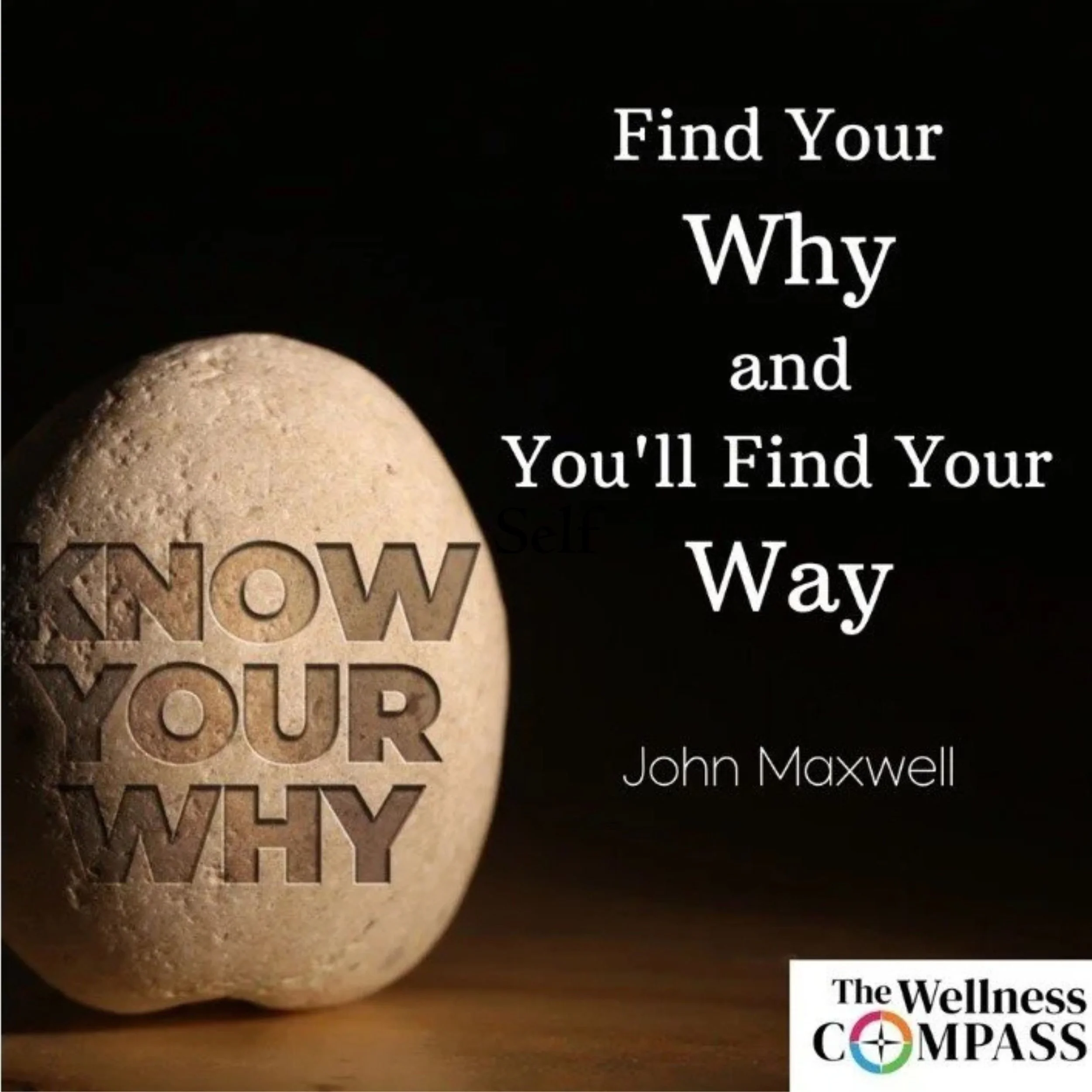
Start With Why
If you would like to join our upcoming Wellness Compass "pop up" session on Thursday, February 26th, 7:00 PM Central Time, click HERE. There are 8 dimensions of wellness in our Wellness Compass and for this session we will focus on the Handling Emotions dimension of wellbeing.
What follows is the weekly column we email every Friday that is a companion to this weekly podcast. This podcast episode expands on the content of the column. You can subscribe to the weekly column HERE.
Start With Why (Part 2 of a six-part series on change).
Most attempts to make a change will fail if they are not connected to a clear "why"—a clear reason for making the change. The "why" is the root system that grounds and nurtures change. Without a strong root system, most attempts at change will wither or die out altogether. For example, if a person makes a New Year’s resolution simply because it’s the popular thing to do, there is a good chance that resolution won’t stick. If, however, a resolution is grounded in a compelling why, it has a much greater chance of lasting.
Author Simon Sinek writes extensively about change. He says most people focus only on the "what" and "how" of a change they want to make, and forget the most essential part—connecting with their "why." For example, a person might decide they want to spend less time on their screens. That's their "what." They may even have a "how"—a plan for doing this. But unless they articulate the deeper "why," their attempt to limit screen time will likely be short-lived. If, however, they can identify why they want to spend less time on screens—to connect more meaningfully with others, pursue other activities, or get more sleep—then there's a greater chance they'll make a lasting change.
All great leaders inspire and facilitate change with a clear "why." Archbishop Desmond Tutu, who passed away in 2021, received the Nobel Peace Prize for his tireless work to end apartheid in South Africa. The “why” that kept him going, even when facing seemingly insurmountable barriers, was his belief that all people are created equal and that the freedom and dignity of every individual must be affirmed and honored. What he did and how he did it evolved and adapted to changing circumstances, but his "why" never wavered. His “why” sustained him his entire life. Such is the power of knowing and connecting with our deeper "why."
This principle has guided a significant change in our own work. Before COVID, our main strategy for our nonprofit Wellness Compass Initiative centered on creating print resources and traveling around the country doing in-person trainings. This approach was effective and personally rewarding, and while it helped us reach thousands of people, its scalability was limited. When COVID hit, we were forced to pivot—developing digital downloads and moving all our trainings and meetings online. Initially, we made these changes simply because circumstances required it.
But here's where the "why" became essential. As the world reopened, we faced a choice: return to our familiar pre-COVID methods or embrace the challenging work of continuing to grow these new digital strategies. We could have easily justified going back to what we knew best. Instead, we chose to press forward with learning new technologies like podcasting and expanding our digital reach. Why? Because our deeper purpose has always been to expand access to wellness resources for as many people as possible.
The changes have been challenging. There's a learning curve to new technology, and we miss the warmth of in-person gatherings. But our reach has expanded in ways we never imagined. Now we are reaching many tens of thousands of people Before COVID, we ran Wellness Circles in person in our local geographic area. Now we facilitate five times as many Wellness Circles, regularly welcoming participants from Europe, South America, and other parts of the world, as well as people just down the street from where we live and work. Our "why"—making high quality wellness resources accessible to organizations and individuals who need them—gave us the motivation to persist through the challenges that change always brings.
Making It Personal
Can you think of a change you have already made in your life that was fueled by a clear “why”? How did it go?
Is there a change you want to make, or are making now, that would be strengthened by connecting it more clearly to a “why"?
What is your "why" for the change you are aspiring to make and how might identifying that help motivate to stick with it?
And please remember to subscribe to this podcast to get updates regarding new episodes. We would also appreciate you reviews and ratings in your app, as well as helping us to grow this nonprofit podcast by sharing it with others. Thank you!
There is a weekly Wellness Compass Column that is emailed each Friday morning that corresponds with this podcast. You can sign up to receive this free weekly email at www.WellnessCompass.org
Sign up for Your Weekly Wellness Compass to receive weekly an email each week that announces when a new podcast episode has been released and also includes a transcription of the episode for those who prefer to read instead of listen. Each episode is designed to help you for navigate your week ahead with clear attention and intention.
Sharing Light in the Darkness
In the 1990’s, there was a children’s show on the Nickelodeon Network that our children and we loved, called Are You Afraid of the Dark? One thing that made the show special was that it was just scary enough, without being terrifying. We find ourselves thinking about that show now as we in the Northern Hemisphere approach the darkest night of the year. There is a lot of fear, a lot of scary things happening in the world, things that can seem dark and overwhelming at times.
As therapists, we find ourselves invited into so many conversations these days about how can one find and how can one be light in the midst of the very real darkness we are seeing in the world.
Fortunately, we are not the first people to encounter this struggle. Each of the world’s spiritual traditions offers wisdom on finding hope, love, and peace—light—in the midst of the darkness of suffering, injustice, and violence.
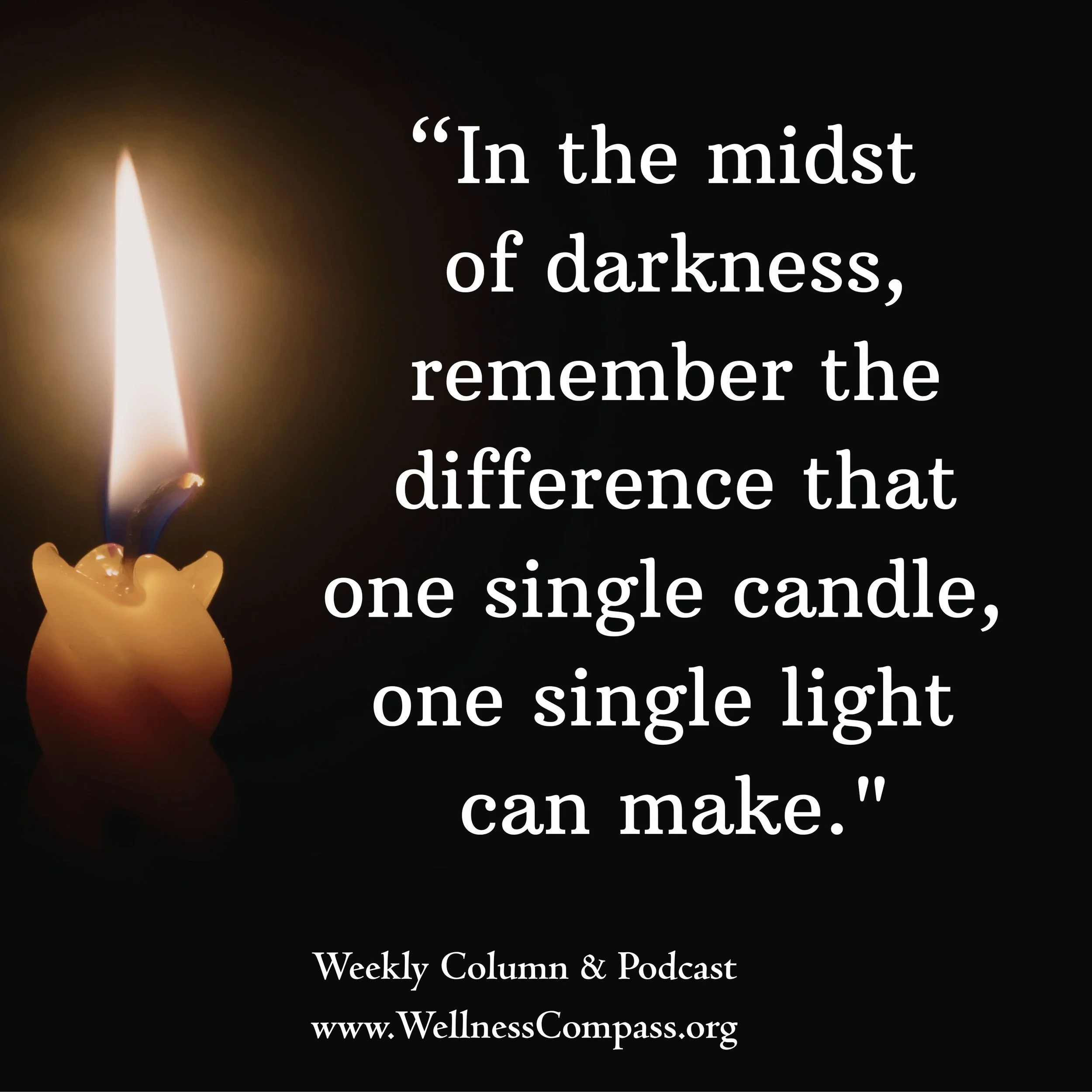
A few years ago, we lost power in our house for several days due to an ice storm. As disruptive as that experience was, we discovered a lesson that has stayed with us. We discovered the difference a single candle can make in a pitch-black room. This experience has stayed with us, especially during difficult times when tragedy strikes our communities or violence erupts in our world. Like many of us, we sometimes feel overwhelmed by the darkness around us, uncertain where to turn or what to do. But then we remember the difference that one small candle, one small light can make.
There's an old saying: "It is better to light one candle than to curse the darkness." For us now, lighting one candle means doing something kind and loving for someone else—some act of service that brings a small amount of light into their world and, little by little, helps brighten our world as a whole.
Here's what's remarkable about sharing light: when you have a lit candle and reach out to light someone else's candle, it in no way diminishes your own light. Unlike money or material resources, we can share the light of hope, love, and kindness with countless others, and still have own light which can continue to burn just as brightly.
As we celebrate the upcoming holidays, may we all commit to being candles of light, spreading love and kindness to all we encounter. The darkness is real and powerful, but the power of love and light is greater still.
Making It Personal:
1. When have you experienced someone lighting a candle of hope for you during a dark time? How did their act of kindness change your perspective or situation?
2. What small act of love or service could you offer this week to bring light into someone else's world?
3. What helps you remember that sharing your light with others doesn't diminish your own? How might this understanding change the way you approach generosity this season?
ABOUT THE CREATORS:
Holly Hughes Stoner, LMFT and Scott Stoner, LMFT, are both licensed marriage and family therapists who are partners in life and in work. They are the Co-Directors and Co-Creators of the Wellness Compass Initiative, a non-profit initiative that crates preventative wellness materials for adults, families, and teens. They live in Madison, Wisconsin and are the parents of three adult children and are blessed with two grandchildren, as well.