
Sharing Awe: What 19,000 Likes Can Teach Us About Supporting One Another's Mental Health
Something unexpected happened after we published our last Wellness Compass column about the Artemis II mission. Nearly 7,000 people shared it, and almost 19,000 offered a "like." We weren't expecting that. We've been sitting with it ever since, asking: what does that response tell us?
We think it's data. Specifically, it's data about how hungry we are — as individuals, as a culture — for good news. For wonder. For awe. For something that lifts our eyes above the noise.
And it turns out our hunches are well supported by recent research on awe.
Dr. Dacher Keltner, professor of psychology at UC Berkeley and founding director of the Greater Good Science Center, has spent decades studying the emotion of awe. He explores these findings in his 2023 book, Awe: The New Science of Everyday Wonder and How It Can Transform Your Life. He defines awe simply as "the feeling of being in the presence of something vast that transcends your current understanding of the world." His research shows that awe isn't just a pleasant feeling — it's a powerful force for mental and physical health.
Artemis II gave millions of people an experience of awe and wonder. Four astronauts flew farther from Earth than any humans had before. They looked back at our planet — this fragile, luminous sphere — and reported a sense of unity, of smallness, of profound beauty. And through the miracle of live coverage, they took us all along for the journey.
Keltner also writes that "tears arise when we perceive vast things that unite us into community.” That was certainly our experience. The shares and likes of our column weren't just people saying they enjoyed an article. They were people passing along a feeling—offering their friends and family a gift, a witness to awe. Experiences of awe and wonder long to be shared and when we do we strengthen our connections with others.
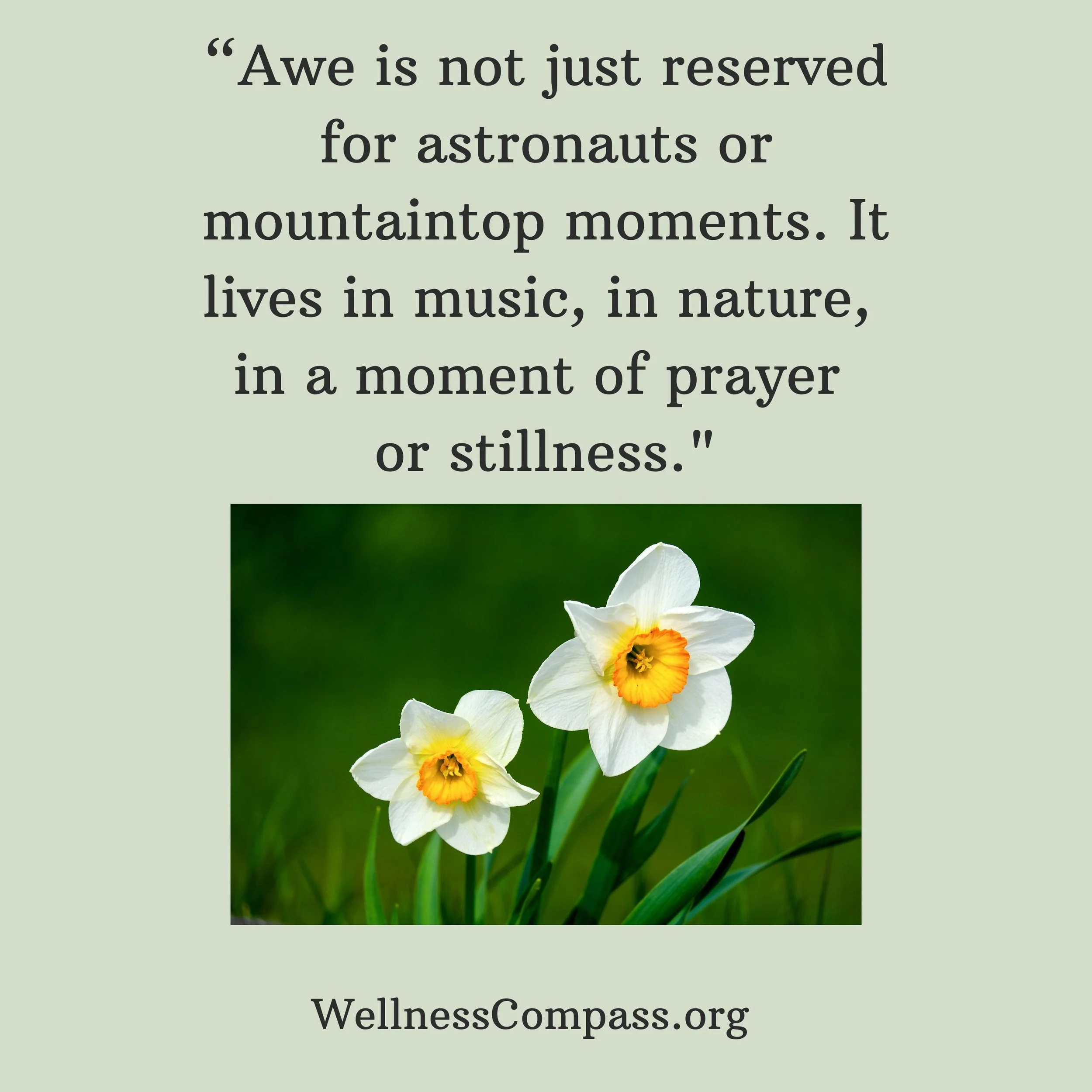
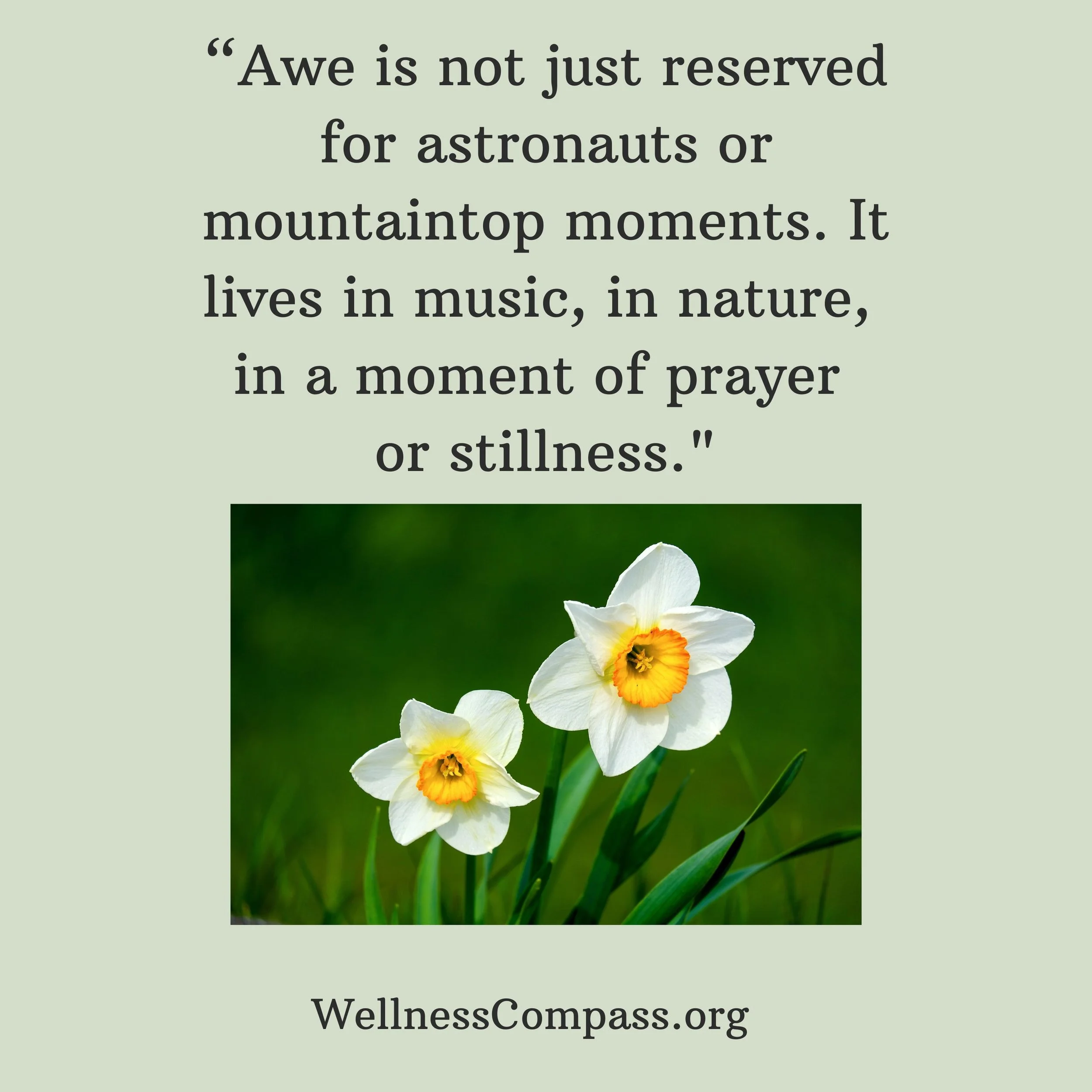
This matters for mental health in a very practical way. Most of us can't fly to the moon. But Keltner's research makes clear that awe is not reserved for astronauts or mountaintops. It is present in daily life, in the sighting of the first spring robin, a kind gesture, a powerful line in a book, a moment of prayer or stillness. It lives in music, in nature, in witnessing acts of moral courage.
Keltner identifies eight distinct wonders of life that can open us to awe:
Moral Beauty: Witnessing others' kindness, acts of courage, overcoming obstacles, and rare talents inspires awe.
Collective Effervescence: Moving in unison stirs the human waves of awe felt within ritual, sport, dance, religion, and public life.
Nature: Immersion in nature and its divinely "wild awe" become spiritual and heals bodies and minds.
Music: Musical awe embraces us as participants and promotes its shared experience and a sense of community.
Visual Design: Visual design and "sacred geometries" help us understand the wonders of life.
Spirituality and Religion: Our spiritual life and religious beliefs—"the fundamental it"—grow out of mystical awe.
Life and Death: Awe helps us understand the cycle of life and death, from childbirth to bearing witness to, yet not knowing what is dying.
Epiphany: Awe allows us to recognize we are part of systems larger than the self: interrelated elements working to achieve a purpose.
The list is both surprising and reassuring — most of these are available to us every single day. Even a few deliberate minutes outdoors, or pausing to notice something beautiful, can be enough to shift our nervous system.
The response to the Artemis column reminded us that people are not, at their core, drawn only to outrage and despair. We are also drawn — powerfully drawn — toward wonder, toward beauty, toward one another. That impulse, the science now confirms, is one of the most life-giving forces we have. Let's keep seeking it and sharing it.
If you want to hear more about our thoughts on this topic, listen to this week’s 10-12 minute episode of the Wellness Compass Podcast, which you can find by clicking on “Podcast” at the top of this page.
Speaking of podcasts, Scott has his own podcast, which is just him speaking about a topic that he is passionate about: the integration of spirituality and wellness. The Living Compass Podcast can be found HERE or in your favorite podcast app. There is also a Living Compass app, with guided meditations, courses, and contemplative practices. The app can be found in any mobile phone App Store, and all the content in the app is available from your web browser by clicking HERE.


