
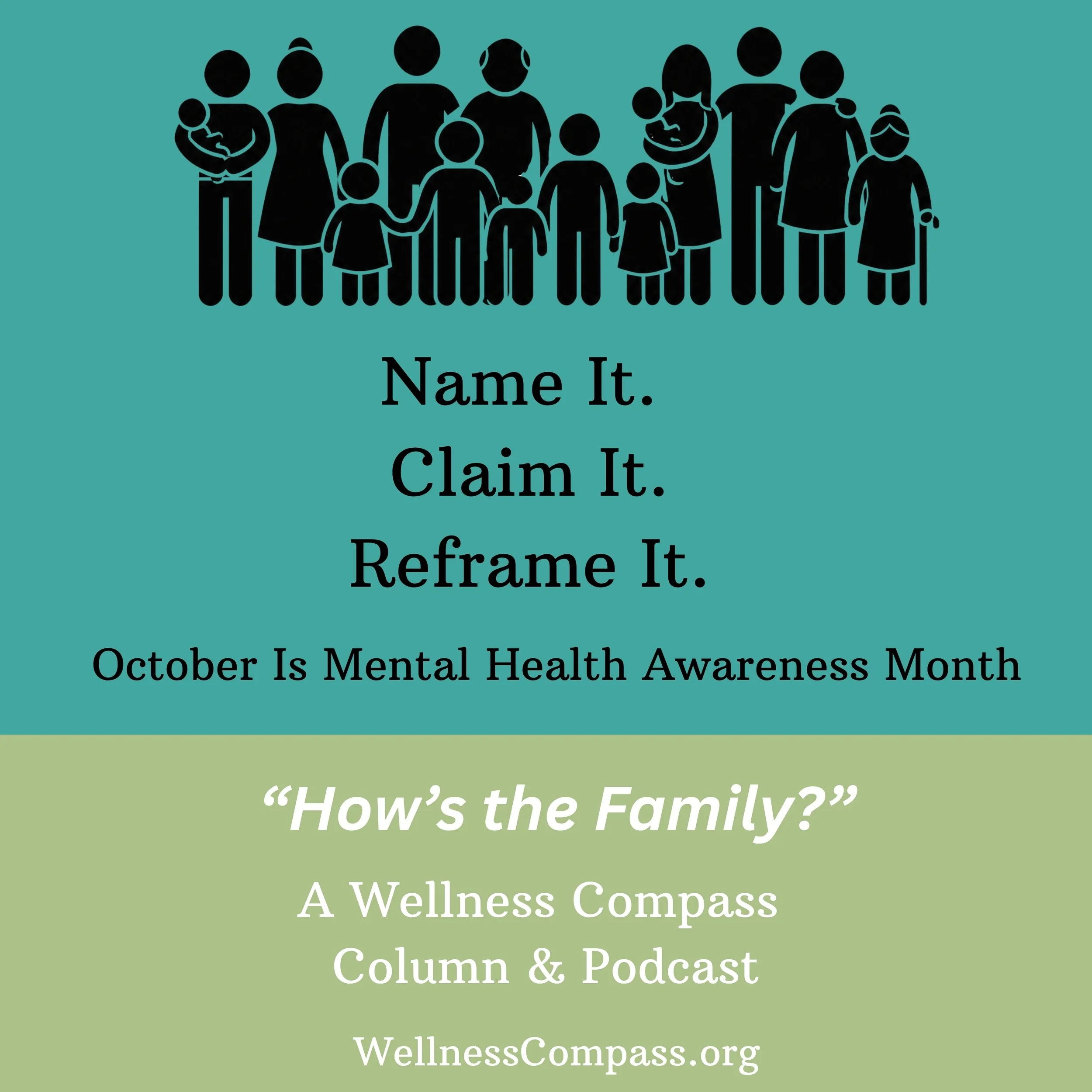
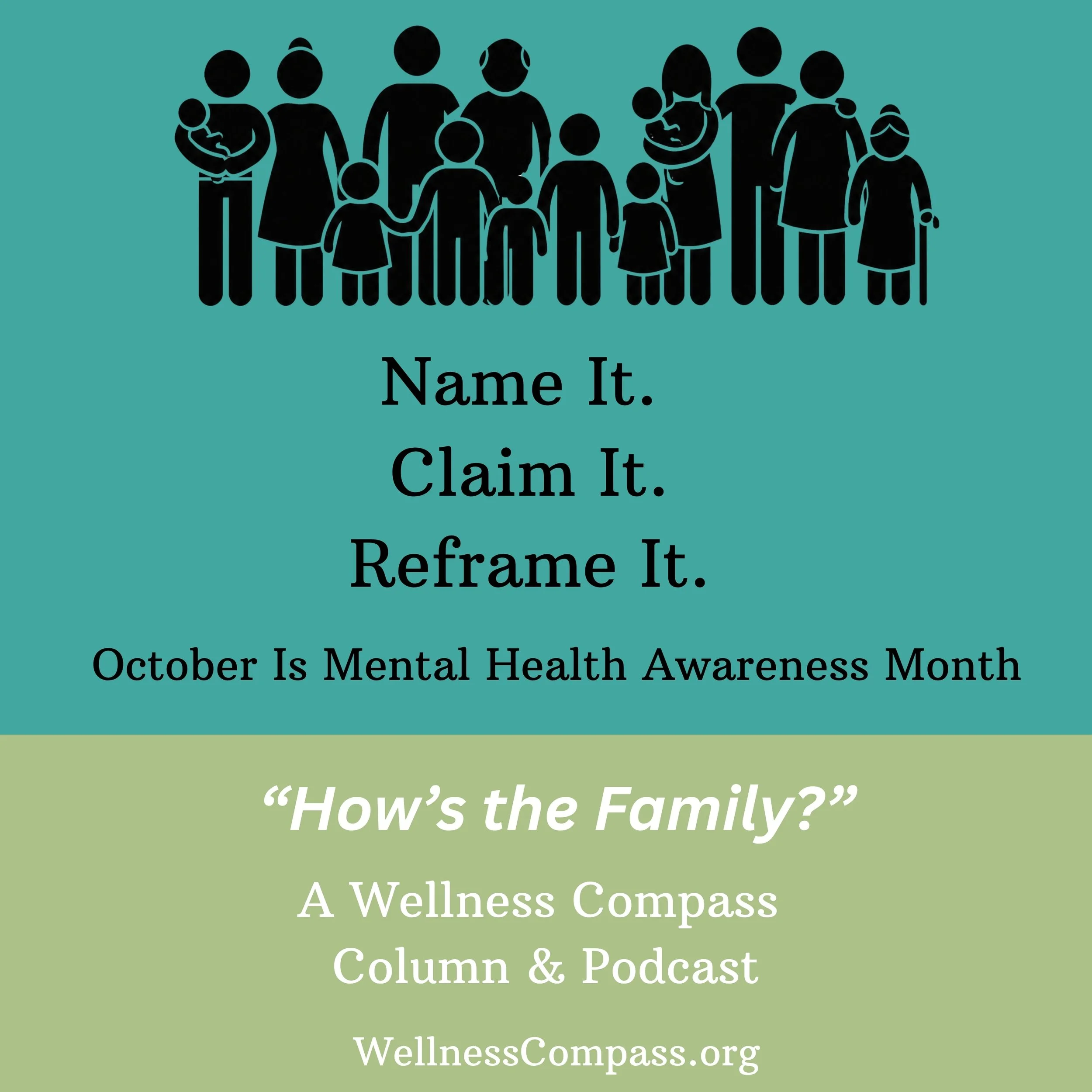
Mental Health: Name It. Claim It. Reframe It
October is Mental Health Awareness Month, a good time to reflect on how we think and talk about mental health in ourselves, our families, and our communities. As marriage and family therapists, we would like to offer a simple three-part way to honor this month: name it, claim it, and reframe it.
Name It
Naming mental health challenges is an essential step toward removing the stigma that still surrounds them. Too often, we describe a struggling person by their behavior rather than by what they are going through. We say, "He's just so negative these days," or "She's been really irritable lately."
Consider how differently we talk about physical health. If someone were short-tempered because of chronic back pain or excruciating migraines, we would naturally say, “She's dealing with migraines, and it's been causing a lot of irritability." We name the condition, and naming it brings understanding and compassion, both to the person and to their relationships.
We hope to become just as comfortable naming mental health challenges as we are naming physical ones. Instead of "He's so negative," we can learn to say, "He's struggling with depression right now." We can say the same about ourselves, “I've been dealing with some anxiety lately."
Naming it also does something important: it separates the person from the challenge. There is a world of difference between saying, "My brother is a depressed person" and "My brother is dealing with depression." The first defines him. The second describes something he is going through, whether a current struggle or a long-standing one. Whether it is Mom, Dad, a sibling, a partner, or ourselves, every person is far more than their mental health challenges.
Claim It
Once we have named what is going on, the next step is to claim it. Claiming has several dimensions.
First, claiming means taking responsibility. When our own mental health is low or ebbing, we can own that without shame. It might sound like, "I know I'm not showing up the way I usually do. It's not that something is wrong between us. I'm dealing with something right now." That kind of honesty helps the people around us understand what is happening, rather than guessing, or worse, assuming they are the cause.
Second, claiming means owning our story. If we or members of our family have a history of mental health challenges, that history is part of our lived experience, just as a history of physical illness or financial hardship would be. It is part of our story, but never our whole story.
Third, claiming means reclaiming our agency. We rarely get to choose whether we, or someone we love, will face mental health challenges. But we can always choose how we respond to them. For example, we can decide to share it with another or keep it to ourselves.
Finally, claiming mental health means making it a priority. When we claim our mental health as something worth caring for, we commit to tending it proactively, rather than waiting for a crisis.
Reframe It
Mental health is often talked about as a purely individual issue. In our work, we think systemically, and we know there is a reciprocal relationship between our mental health and our relationships.
A person's mental health affects their family, their extended family, and the wider network of relationships they are part of. In turn, what is happening in that family and network of relationships affects the mental health of each person in it.
We often use the image of a mobile to describe this. Every piece of a mobile is connected to every other piece. Move one, and all the others move too. And when the whole mobile is in motion, each individual piece is affected.
This reframe widens our lens. Mental health challenges are both individual and systemic. Neither is more important than the other; they are interconnected. So when we seek help or work to address a mental health challenge, we want to include that family systems perspective, paying attention not only to the person, but to the relationships that surround them as well.
Honoring Mental Health Awareness Month
This October, let's honor Mental Health Awareness Month by naming it, claiming it, and reframing it. When we do, not only does our own well-being benefit, but so do all of our relationships: our friends, our families, and the wider circle of people whose lives are connected to ours.
We extend our gratitude to all who shared responses to our question last time of “How’s the Family?” Thank you for sharing the joys and challenges in your extended family.
We welcome your feedback as well as your questions. If there is a particular question you have about family relationships that you would like us to address in a future column, please email it to us. (You can simply reply to this email, or you can email Holly at holly@WellnessCompass.org or Scott at Scott@WellnessCompass.org.)
If we share your question and our response to it, we will guarantee your anonymity and make sure that no personally identifying details are shared. There's a good chance that if you have a question about something happening in your family, many other readers of our column and listeners to our podcast have a very similar question.
Our column and podcast will appear every other week through next Memorial Day.
If you want to hear more about our thoughts on this topic, listen to this week’s 10-12 minute episode of the Wellness Compass Podcast, which you can find by clicking on “Podcast” at the top of this page.
Speaking of podcasts, Scott has his own podcast, which is just him speaking about a topic that he is passionate about: the integration of spirituality and wellness. The Living Compass Podcast can be found HERE or in your favorite podcast app. There is also a Living Compass app, with guided meditations, courses, and contemplative practices. The app can be found in any mobile phone App Store, and all the content in the app is available from your web browser by clicking HERE.


