
(Click on the player at the top to listen to this ten-minute episode)
"Love as Practice: Beyond the Feelings of Valentine's Day”
What follows is the weekly column we email every Friday that is a companion to this weekly podcast. This podcast episode expands on the content of the column. You can subscribe to the weekly column HERE.
"Love as Practice: Beyond the Feelings of Valentine's Day
Valentine's Day invites us to celebrate love with cards, flowers, and chocolates—gestures that honor the warm feelings we have for the people we care about. Feelings are an important aspect of love, but love is so much more than that. What sustains love through ordinary days, difficult seasons, and genuine hardship?
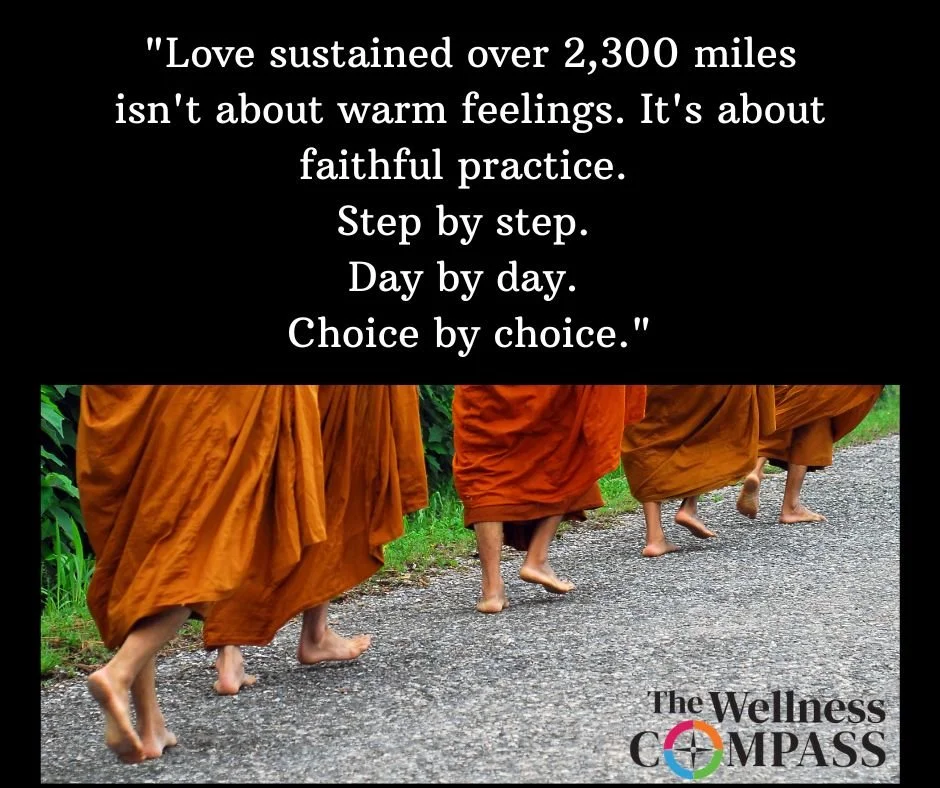
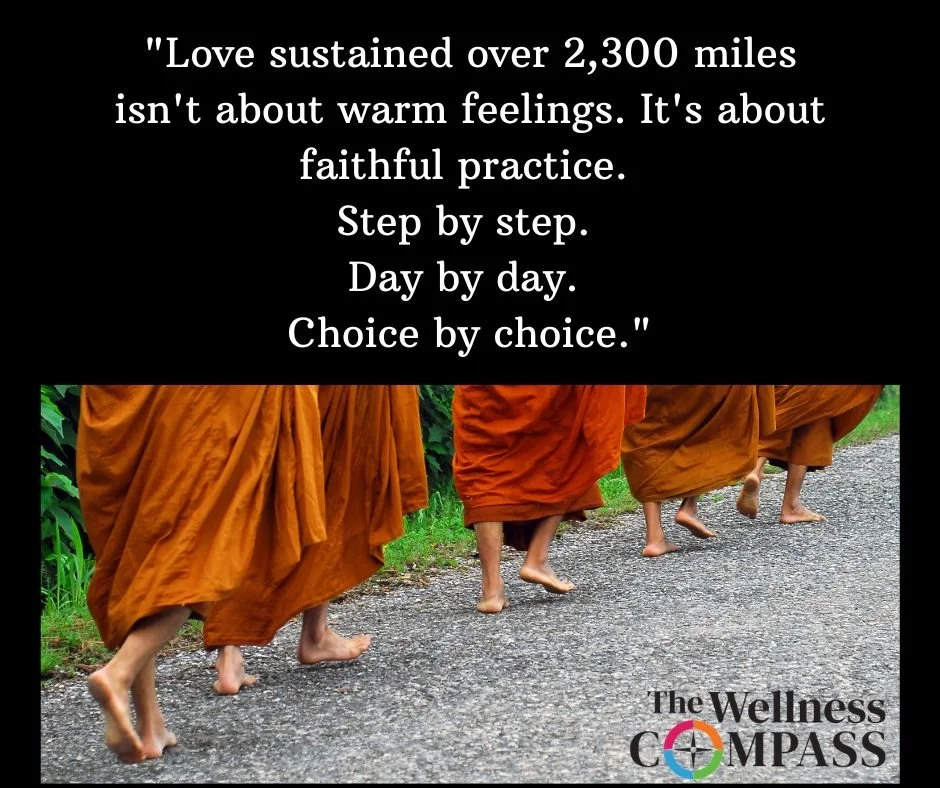
This week, nineteen Buddhist monks completed a 2,300-mile walk from Texas to Washington, D.C., covering over twenty miles each day for 108 days. Some walked barefoot. Some nights they slept in tents in the midst of freezing weather. Early in their journey, their escort vehicle was struck by a distracted driver, and one monk lost his leg. Rather than responding with anger or litigation, the monks offered compassion and continued their pilgrimage.
Their journey teaches us something essential: love is not primarily a feeling. Love is an embodied practice—a decision we make again and again through our actions.
American scholar and author bell hooks wrote that, "Love is an act of will—namely, both an intention and an action." She insisted that love requires care, commitment, knowledge, responsibility, respect, and trust. These aren't emotions that wash over us. They're disciplines we can choose to cultivate, day after difficult day.
This understanding has for centuries appeared across wisdom traditions as well. In the Bible, for example, in 1 Corinthians 13, love is described not as a feeling but as a series of actions: love is patient, love is kind, love does not keep a record of wrongs. These are choices, not sentiments. They require intention and practice.
The monks' walk demonstrates this truth beautifully. When faced with injury and loss, they couldn’t rely solely on positive feelings to carry them forward. They instead relied on their commitment to peace—a commitment expressed through every mindful step, every tent pitched in the cold, every encounter with strangers along the highway.
Their example has profound implications for our relationships. When we understand love as practice rather than feeling, we stop waiting for the emotion to show up before we act lovingly. We show up for our partner even when we're frustrated. We offer kindness to our children even when we're exhausted. We extend compassion to
ourselves even when we feel unworthy of it.
Love as practice means recognizing that the small, unglamorous choices matter most: listening when we'd rather talk, pausing before reacting, choosing forgiveness over resentment, showing up consistently rather than dramatically. These daily disciplines build the foundation that feelings alone cannot sustain.
So this Valentine's Day, by all means celebrate with flowers and chocolates. But also ask yourself: What loving actions will I practice even when the warm, affectionate feelings aren't always there? How will I embody love even when it costs me something? What am I willing to walk twenty miles a day for?
The monks teach us that love sustained over 2,300 miles isn't about warm feelings. It's about faithful practice. Step by step. Day by day. Choice by choice.
That's the love that endures.
And please remember to subscribe to this podcast to get updates regarding new episodes. We would also appreciate you reviews and ratings in your app, as well as helping us to grow this nonprofit podcast by sharing it with others. Thank you!
There is a weekly Wellness Compass Column that is emailed each Friday morning that corresponds with this podcast. You can sign up to receive this free weekly email at www.WellnessCompass.org
Sign up for Your Weekly Wellness Compass to receive weekly an email each week that announces when a new podcast episode has been released and also includes a transcription of the episode for those who prefer to read instead of listen. Each episode is designed to help you for navigate your week ahead with clear attention and intention.
Sharing Light in the Darkness
In the 1990’s, there was a children’s show on the Nickelodeon Network that our children and we loved, called Are You Afraid of the Dark? One thing that made the show special was that it was just scary enough, without being terrifying. We find ourselves thinking about that show now as we in the Northern Hemisphere approach the darkest night of the year. There is a lot of fear, a lot of scary things happening in the world, things that can seem dark and overwhelming at times.
As therapists, we find ourselves invited into so many conversations these days about how can one find and how can one be light in the midst of the very real darkness we are seeing in the world.
Fortunately, we are not the first people to encounter this struggle. Each of the world’s spiritual traditions offers wisdom on finding hope, love, and peace—light—in the midst of the darkness of suffering, injustice, and violence.
A few years ago, we lost power in our house for several days due to an ice storm. As disruptive as that experience was, we discovered a lesson that has stayed with us. We discovered the difference a single candle can make in a pitch-black room. This experience has stayed with us, especially during difficult times when tragedy strikes our communities or violence erupts in our world. Like many of us, we sometimes feel overwhelmed by the darkness around us, uncertain where to turn or what to do. But then we remember the difference that one small candle, one small light can make.
There's an old saying: "It is better to light one candle than to curse the darkness." For us now, lighting one candle means doing something kind and loving for someone else—some act of service that brings a small amount of light into their world and, little by little, helps brighten our world as a whole.
Here's what's remarkable about sharing light: when you have a lit candle and reach out to light someone else's candle, it in no way diminishes your own light. Unlike money or material resources, we can share the light of hope, love, and kindness with countless others, and still have own light which can continue to burn just as brightly.
As we celebrate the upcoming holidays, may we all commit to being candles of light, spreading love and kindness to all we encounter. The darkness is real and powerful, but the power of love and light is greater still.
Making It Personal:
1. When have you experienced someone lighting a candle of hope for you during a dark time? How did their act of kindness change your perspective or situation?
2. What small act of love or service could you offer this week to bring light into someone else's world?
3. What helps you remember that sharing your light with others doesn't diminish your own? How might this understanding change the way you approach generosity this season?
ABOUT THE CREATORS:
Holly Hughes Stoner, LMFT and Scott Stoner, LMFT, are both licensed marriage and family therapists who are partners in life and in work. They are the Co-Directors and Co-Creators of the Wellness Compass Initiative, a non-profit initiative that crates preventative wellness materials for adults, families, and teens. They live in Madison, Wisconsin and are the parents of three adult children and are blessed with two grandchildren, as well.


