
(Click on the player at the top to listen to this ten-minute episode)
What follows is the weekly column we email every Friday that is a companion to this weekly podcast. This podcast episode expands on the content of the column. You can subscribe to the weekly column HERE.
The Spirit (and Neuroscience) of Generosity
The holidays are a time for gift giving and generosity. Nonprofits receive more donations of both money and volunteer hours this time of year than at any other time. With that in mind, we offer a few thoughts on practicing generosity—not just during the holidays, but all year long.
Our Brains Are Wired for Generosity
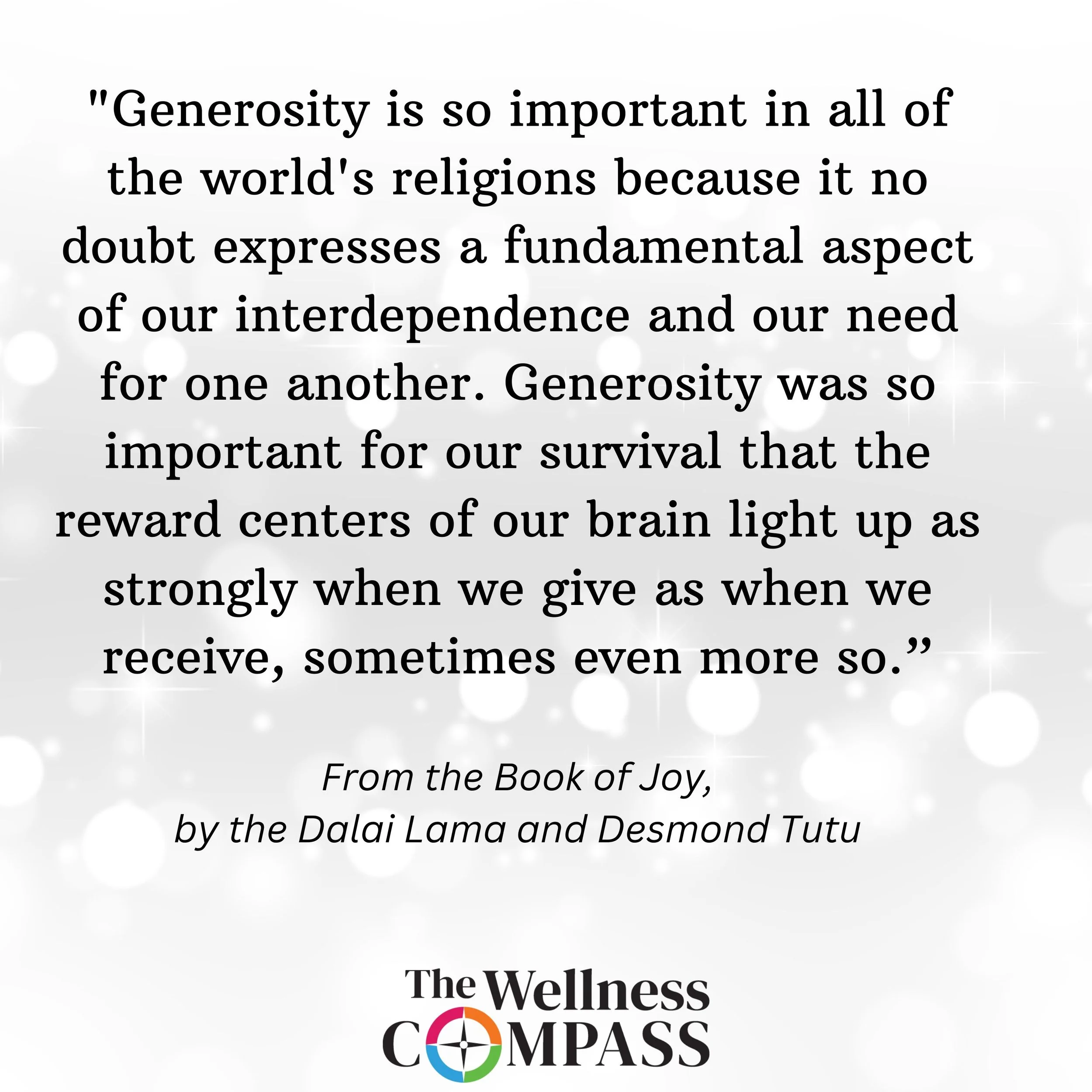
The Dalai Lama and Archbishop Desmond Tutu, in their book entitled The Book of Joy, remind us that generosity is fundamental by saying the following, "Generosity is so important in all of the world's religions because it no doubt expresses a fundamental aspect of our interdependence and our need for one another. Generosity was so important for our survival that the reward centers of our brain light up as strongly when we give as when we receive, sometimes even more so.” Modern neuroscience confirms this ancient wisdom. We are literally hardwired for generosity.Our Gifts Can Go Beyond the Material
While material gifts can be meaningful, many of the most significant forms of generosity often cost nothing. The gift of presence—truly listening to someone who needs to be heard—activate our neural reward pathways. So does offering forgiveness, sharing a burden, or bearing witness to another's joy or pain. These exchanges of care create the web of interdependence that sustains us.
Hospitality Can Be a Gift
A friend recently shared a formative memory. Every Christmas, her parents invited people they knew who were alone to join them for dinner—someone from work, a neighbor, someone from church. She said those experiences taught her more about the meaning of the holidays than any material gift she ever received.
Generosity Transforms Hearts
How the Grinch Stole Christmas and A Christmas Carol are beloved because both the Grinch and Scrooge are transformed by embracing joy and generosity. Hearts that were two sizes too small become enlarged.
This holiday season, let’s commit to practicing generosity in all its forms as we give warmth freely, receive graciously, and notice how both nourish our connections with others.
Making It Personal:
1. Think of a time when someone offered you the gift of their presence—truly listening or simply staying with you through something difficult. What made that moment meaningful? How did it feel?
2. Like the Grinch or Scrooge, where in your life right now might you be resisting generosity (think time, attention, forgiveness, or resources)? What would it feel like if you worked so that part of your heart grew larger?
3. If you were to create your own ritual of generosity—whether during holidays or throughout the year—what would it look like? Who might you include, and what would you want others to feel from witnessing this practice?f
And please remember to subscribe to this podcast to get updates regarding new episodes. We would also appreciate you reviews and ratings in your app, as well as helping us to grow this nonprofit podcast by sharing it with others. Thank you!
There is a weekly Wellness Compass Column that is emailed each Friday morning that corresponds with this podcast. You can sign up to receive this free weekly email at www.WellnessCompass.org
Sign up for Your Weekly Wellness Compass to receive weekly an email each week that announces when a new podcast episode has been released and also includes a transcription of the episode for those who prefer to read instead of listen. Each episode is designed to help you for navigate your week ahead with clear attention and intention.
ABOUT THE CREATORS:
Holly Hughes Stoner, LMFT and Scott Stoner, LMFT, are both licensed marriage and family therapists who are partners in life and in work. They are the Co-Directors and Co-Creators of the Wellness Compass Initiative, a non-profit initiative that crates preventative wellness materials for adults, families, and teens. They live in Madison, Wisconsin and are the parents of three adult children and are blessed with two grandchildren, as well.


